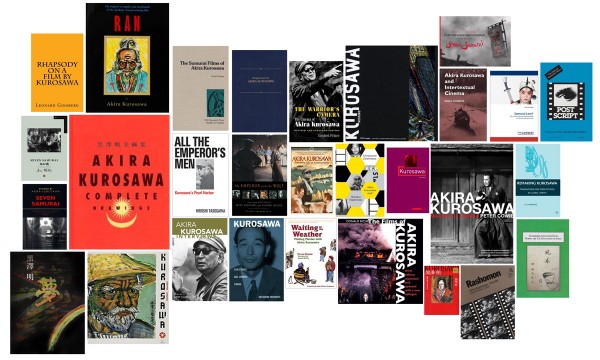
This page is a comprehensive list of all English language books devoted to Akira Kurosawa and his works. The single exception are published screenplays, which are not included here. Furtheremore, the art book section includes some non-English books as well.
Contents:
Biographies and Memoirs
- Akira Kurosawa (Peter Wild)
- All the Emperor’s Men: Kurosawa’s Pearl Harbor (Hiroshi Tasogawa)
- Compound Cinematics: Akira Kurosawa and I (Shinobu Hashimoto)
- The Emperor and the Wolf (Stuart Galbraith IV)
- Something Like an Autobiography (Akira Kurosawa)
- Waiting on the Weather: Making Movies with Akira Kurosawa (Teruyo Nogami)
Career Spanning Studies
- Akira Kurosawa: A Viewer’s Guide (Eric San Juan)
- Akira Kurosawa And Modern Japan (David A. Conrad)
- The Films of Akira Kurosawa (Donald Richie)
- Kurosawa: Film Studies and Japanese Cinema (Mitsuhiro Yoshimoto)
- The Warrior’s Camera: The Cinema of Akira Kurosawa (Stephen Prince)
Collections of Essays, Interviews and Articles
- Akira Kurosawa: Interviews (ed. Bert Cardullo)
- Perspectives on Akira Kurosawa (ed. James Goodwin)
- Post Script: The Films of Kurosawa Akira (ed. Keiko McDonald)
- Rashomon (ed. Donald Richie)
- Rashomon Effects (ed. Davis, Anderson & Walls)
Books With a Specific Focus
- Akira Kurosawa and Intertextual Cinema (James Goodwin)
- Censorship of Japanese Films… (Lars-Martin Sorensen)
- Everything I Know About Filmmaking… (Richard D. Pepperman)
- On Kurosawa: A Tribute to the Master Director (Peter Tasker)
- Remaking Kurosawa: Translations and Permutations in Global Cinema (D. P. Martinez)
- Rhapsody on a Film by Akira Kurosawa (Leonard Ginsberg)
- The Samurai Films of Akira Kurosawa (David Desser)
- Samurai Lear? (Karl Gorringe)
- Seven Samurai (Joan Mellen)
- Seven Samurai (Roy Stafford)
Art Books
- Akira Kurosawa: Complete Drawings (Akira Kurosawa)
- Akira Kurosawa: Dessins (Akira Kurosawa)
- Akira Kurosawa: Kadokawa Art Selection (Akira Kurosawa)
- Akira Kurosawa: Master of Cinema (Peter Cowie)
- Kurosawa: Desenler (Drawings) (Akira Kurosawa)
- Ran: Original Screenplay & Storyboards (Akira Kurosawa)
- Yume (Akira Kurosawa)
Biographies and Memoirs
Akira Kurosawa
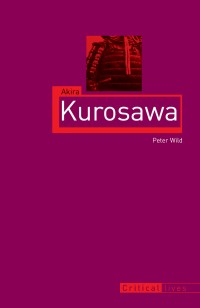 by Peter Wild
2014, Reaktion Books, 208 pages
Peter Wild’s Akira Kurosawa is one of those books where every paragraph seems to have been very carefully thought out to conserve space and maximise information density. Yet, it is also very accessible and readable, for which the author must be commended. In just 208 pages, Wild proceeds through Kurosawa’s career chronologically, touching on all the major parts of his life and never lingering on a single film any longer than is absolutely necessary. More space is understandably given for films like Rashomon and Seven Samurai, but by and large each film is afforded between three and ten pages.
All in all, Akira Kurosawa is an excellent introduction to Kurosawa’s life and career, and may well be the best English language introduction for someone who is interested in Kurosawa, yet knows only little about his life and wants the basic story without additional details.
However, those who are already familiar with Kurosawa’s life and career will find the book less valuable as it ultimately contains very little that is new or original. In consequence, Akira Kurosawa works primarily as a summary of what has been written before, but considering that it was published as part of the publisher’s “Critical Lives” series, it must be assumed that this indeed was its exact purpose.
A slightly longer review of the book is available here.
As a fairly recent publication, Peter Wild’s Akira Kurosawa is available from most well stocked bookshops, including Amazon.com, Amazon.co.uk, Amazon.de and Amazon.co.jp.
All the Emperor’s Men: Kurosawa’s Pearl Harbor
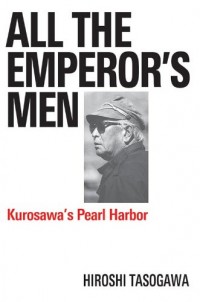 by Hiroshi Tasogawa
2012, Applause, 337 pages
Hiroshi Tasogawa’s All the Emperor’s Men concentrates on the period of time between 1966 and 1968, when Kurosawa worked on the Hollywood World War II spectacle Tora! Tora! Tora!, responsible for the Japanese half of the film. What started as a gigantic undertaking for an energetic Kurosawa and his production company, ended in December 1968 after much hardship and only three weeks of actual shooting, with the Hollywood producers effectively firing the director and rumours floating around that he was mentally unstable.
Tasogawa’s book sets out to unveil how this came to be. The author worked as a translator and interpreter for Kurosawa during the film’s production, allowing him an insider’s view into what really happened. Having also worked as a journalist, reporter and academic, the book is also the result of a decade’s worth of research, giving him a new vantage point which was further enhanced by his interviews with many of the key players.
The result is an extremely well written book, which is a joy to read and very difficult to put down. It is thoroughly researched and sets out to give out all the available facts, with Tasogawa’s ability to juggle the minute details and put them into a coherent narrative nothing short of impressive. All the Emperor’s Men is easily one of the best Kurosawa books available in the English language and there is absolutely no problem recommending it to anyone interested in Kurosawa or film history in general. A longer review can be found here.
All the Emperor’s Men: Kurosawa’s Pearl Harbor is in print and available from bookshops such as Amazon.com, Amazon.co.uk, Amazon.de, and Amazon.co.jp.
Compound Cinematics: Akira Kurosawa and I
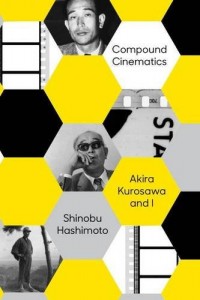 by Shinobu Hashimoto
2015, Vetical Inc, 256 pages
Written by Akira Kurosawa‘s longtime co-screenwriter Shinobu Hashimoto, Compound Cinematics is the first book to concentrate on Kurosawa’s collaborative screenwriting practices. Originally published in 2006 in Japan, it was made available in English by Vertical Inc. and it is a book very much worth picking up.
Compound Cinematics is a part memoir, part novel, part testament, part screenplay and part argument for a new type of cinema. It is also a brilliantly written and certainly a thought provoking account by a man who is partially responsible for at least half a dozen of cinema’s greatest achievements. As a Kurosawa book it gives you much new information, as well as an angle into the director’s works that you may not have considered before. It does not offer many insights into Kurosawa’s private life, but it does describe in detail the process that led to the screenplays of Kurosawa’s films.
Compound Cinematics can be warmly recommended to anyone, regardless of whether you are interested in Kurosawa, Japanese cinema, screenwriting or just a good story. It is a joy to read and a pleasure to think about.
Compound Cinematics: Akira Kurosawa and I is available from bookshops such as Amazon.com, Amazon.co.uk, Amazon.de, and Amazon.co.jp.
The Emperor and the Wolf:
The Lives and Films of Akira Kurosawa and Toshiro Mifune
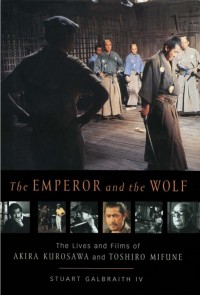 by Stuart Galbraith IV
2002, Faber and Faber, 848 pages
In its almost 850 pages, Stuart Galbraith IV’s massive The Emperor and the Wolf sets out to trace the lives and works of Akira Kurosawa and Toshirō Mifune. The result is the most comprehensive English biography on either man, and one of the best books on Kurosawa.
The Emperor and the Wolf is a wonderful and jam packed source of information that has been painstakingly researched by Galbraith. Although subtitled “the lives and films”, the book primarily concentrates on the latter, with the private lives of the two men remaining less well explored. This is understandable, however, considering the private nature of both individuals, as well as the fact that even in its current form, the book is massive.
In fact, the only real criticism about the book would be that it contains so much information that at some points the readability suffers as the author does his best to include all the details, which sometimes happens with the expense of the narrative style. This problem could perhaps have been averted had the book concentrated only on one of its subjects, but the choice of presenting them both together is of course understandable.
In addition to being a great read, The Emperor and the Wolf is an invaluable reference book and a treasure trove of information about Kurosawa and Mifune that, thanks to its excellent index, you can go back to over and over again. For anyone even remotely interested in Kurosawa, The Emperor and the Wolf is very much a must read. And this is of course doubly true if you are also curious about the life of Toshirō Mifune.
The availability of The Emperor and the Wolf could be better, as it has not been reprinted since the first edition. It is nevertheless still available from many bookshops, including Amazon.com, Amazon.co.uk, Amazon.de and Amazon.co.jp.
Something Like an Autobiography
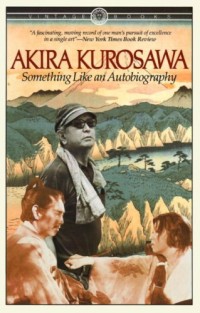 by Akira Kurosawa
translated by Audie E. Bock
1982 (English 1983), Vintage, 205 pages
Akira Kurosawa’s autobiography is an interesting book. Its Japanese title Gama no abura translates as “An Oily Toad” and refers to a popular pre-war home remedy which could supposedly be attained by placing a deformed toad into a box full of mirrors. The toad, seeing its own reflection in each direction, would begin to sweat, and after collecting and simmering that sweat for 3,721 days, the result could be used to heal burns and cuts. Kurosawa opens his book by admitting that he feels like such a toad.
Kurosawa wrote his autobiography in the early 1980s but it only covers his life up until the production and reception of Rashomon (1950). It has furthermore been suggested that what is included reads at times more like a screenplay than an entirely honest and open biographical account, and this is also something that the author himself admits in the closing words of his book, suggesting that the real Kurosawa can be found in his films.
Despite what could be seen as its shortcomings, Something Like an Autobiograhy is full of interesting insights into Kurosawa’s working methods, thought processes and world view, and must be wholeheartedly recommended.
Something Like an Autobiography is widely available from most bookshops, including Amazon.com, Amazon.co.uk, Amazon.de and Amazon.co.jp.
Waiting on the Weather: Making Movies with Akira Kurosawa
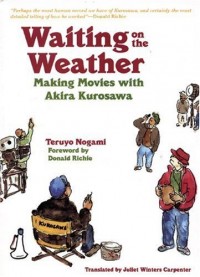 by Teruyo Nogami
translated by Juliet Winters Carpenter
2001 (English 2006), Stone Bridge Press, 296 pages
The first thing that one notices about Teruyo Nogami’s Waiting on the Weather is that it is a collection of largely unconnected writings on Kurosawa, rather than a single coherent narrative work. While the patchiness of the book may at first make the reading experience somewhat disorienting, what one loses in cohesion one gains in the numerous unique insights and details that Nogami serves the reader about Kurosawa. This is, of course, exactly what one would expect from someone like Nogami who spent over four decades working with the director.
In the first half of the book, Nogami covers her background in the film industry and her early career with Kurosawa, while the second half features a long chapter on the shooting of Dersu Uzala, chapters titled “Kurosawa and Animals” and “Kurosawa and Music”, as well as recollections about Kurosawa’s crew and anecdotes about the director’s meetings with other famous filmmakers. The book could have done with some further editing as some of the chapters repeat each other slightly, while the biggest omission has to be the lack of a real index at the back of the book, making Waiting on the Weather an unfortunately difficult reference book for the subjects that it discusses.
Yet, all in all Waiting on the Weather is a marvellous source of information about Kurosawa’s life and working methods, and also the most personal of all Kurosawa publications currently available in English. It may not be quite as extensive as some of the other books written about Kurosawa, but it certainly gives one a behind-the-scenes look in a way that no other book available in English has done. It is also a delightful and light read, which should definitely find its place on every Kurosawa fan’s bookshelf.
Waiting on the Weather: Making Movies with Akira Kurosawa is available at most bookshops, including Amazon.com, Amazon.co.uk, Amazon.de and Amazon.co.jp.
Career Spanning Critical Studies
Akira Kurosawa: A Viewer’s Guide
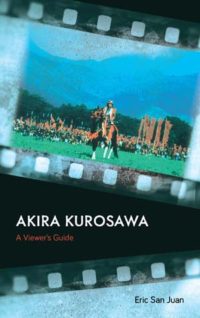 by Eric San Juan
2018, Rowman & Littlefield Publishers, 260 pages
Eric San Juan’s Akira Kurosawa: A Viewer’s Guide provides a comprehensive, yet easily accessible examination of Kurosawa’s entire oeuvre. It was written for a reader who is interested in learning more about Kurosawa’s films but is not ready to tackle the earlier and fairly academic career spanning studies that have been published in English. It was also intended for those who know Kurosawa only for his samurai films and wonder what lies beyond.
It’s an excellent book to start your exploration of Kurosawa with if you are intimidated by the more scholarly approaches mentioned on this page. On the other hand, if you are already fairly familiar with Kurosawa and have engaged with previous books by authors like Richie, Prince, Yoshimoto, Galbraith and the rest, the book will not contain all that much new for you. You can find out more from my full review.
Akira Kurosawa: A Viewer’s Guide is available from Amazon.com, Amazon.co.uk, Amazon.de and Amazon.co.jp.
Akira Kurosawa And Modern Japan
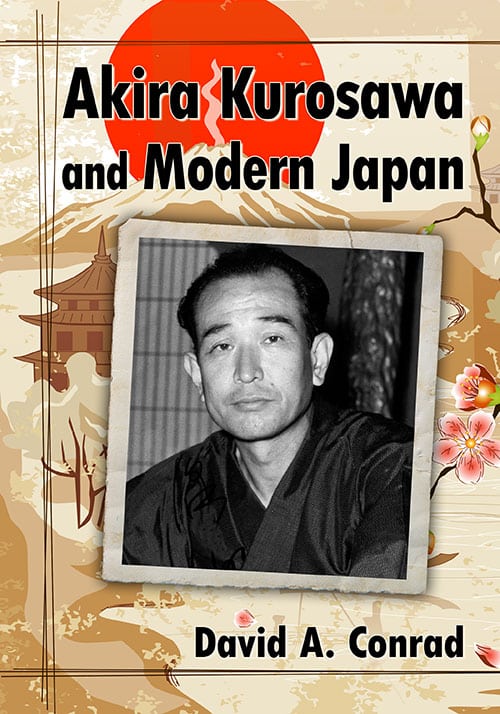 by David A. Conrad
2022, McFarland, 260 pages
David A. Conrad’s Akira Kurosawa And Modern Japan looks at the historical, political and social contexts in which Kurosawa made his films. For each of Kurosawa’s films, the book introduces a topic which somehow influenced the film or should probably influence its interpretation. For instance, the book’s chapter on Rashomon discusses the Korean War, as well as noting the contemporary discussion of sexual assault in Japan. The one on Ikiru takes a look at the Japanese bureaucratic system after the war, the healthcare system and the national pension system, while the chapter dedicated to Seven Samurai discusses the social structures of class and caste, as well as equating the samurai’s arrival to the village with the arrival of the Americans to Japan after the Second World War, and the establishment of Japan’s Self Defence Force.
While these are fairly complex topics, the book benefits greatly from having been written in a very clean and easy-to-read style that allows it to flow naturally, almost conversationally, making the book a real pleasure to read. The author has also been excellent at distilling these topics to their basic components and concentrating on the essential.
If you have any interest in the historical contexts in which Kurosawa made his films, I would definitely recommend this book. You can also find my full review here.
Akira Kurosawa and Modern Japan is available directly from the publisher McFarland, as well as from places like Amazon.com and Amazon.co.uk.
The Films of Akira Kurosawa
 by Donald Richie
some chapters by Joan Mellen
3rd edition 1998, University of California Press, 280 pages
First published in 1965, Donald Richie’s book on Akira Kurosawa is something of a legend. It is not only the starting point of practically all English language discussion on Kurosawa’s films, but in many ways it is also the work to which every other book dealing with films of any kind could be compared. The book has gone through a few revisions over the years, with the black covered 3rd edition from 1998 that contains an epilogue for the then recently passed away director the final and most definitive incarnation of the work.
The Films of Akira Kurosawa is, in its basic format, a collection of essays, one for each of Kurosawa’s films. It should be noted that Kurosawa’s last films do not receive Richie’s full interest, as the author clearly prefers the director’s works from the 1950s and 60s. Nevertheless, The Films of Akira Kurosawa is not only a must-read, but indeed a must-have for anyone seriously interested in Kurosawa and his cinematic works.
A word of warning, however. Richie is somewhat notorious for not always double checking his facts, and the book contains a number of mistakes and misunderstandings which have remained even through the various revisions. This is partly due to the circumstances in which most of these essays were written, as no access to home video recordings was possible. Because of this, The Films of Akira Kurosawa is not of quite as high academic standard as many other books written on Kurosawa, yet his is the book that everyone refers to, and if you intend to explore the wider discussion of Kurosawa’s films in English, familiarity with Richie is, if not absolutely crucial, at least highly recommended.
The Films of Akira Kurosawa is available everywhere, including Amazon.com, Amazon.co.uk, Amazon.de and Amazon.co.jp.
Kurosawa: Film Studies and Japanese Cinema
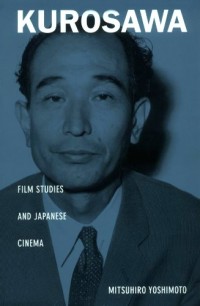 by Mitsuhiro Yoshimoto
2000, Duke University Press, 496 pages
Something of a personal favourite, Mitsuhiro Yoshimoto’s Kurosawa: Film Studies and Japanese Cinema looks at Kurosawa’s films one at a time, devoting a chapter to each of the director’s works. These essays range considerably in length, from one page to around fifty, depending on a film and how much Yoshimoto has to say about it or topics connected to it.
Yoshimoto’s analysis of Kurosawa’s artistic output questions many of the commonly held assumptions, frameworks and methods that have traditionally been employed in Japanese film criticism. His central argument is that Kurosawa’s works problematise both Japan’s self-image as well the West’s image of Japan, and by doing so arouse confusion and anxiety in film critics in both Japan and elsewhere. This, in Yoshimoto’s view, has for certain ideological purposes led to an artificial manufacturing of the very concept of “Japanese Cinema”, with Kurosawa’s works having been used at the centre of this process.
While the central thesis of Kurosawa: Film Studies and Japanese Cinema is thus borne from a reaction to earlier critical works, Yoshimoto’s book is never solely an exercise in the theory of criticism and doesn’t even require any real background knowledge. His analyses of Kurosawa’s works are some of the most thorough and inspiring takes on the subject available in the English language. Highly recommended.
Kurosawa: Film Studies and Japanese Cinema is widely available and can be purchased for instance from Amazon.com, Amazon.co.uk, Amazon.de and Amazon.co.jp.
The Warrior’s Camera: The Cinema of Akira Kurosawa
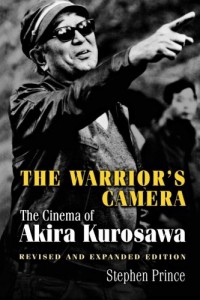 by Stephen Prince
expanded edition 1999, Princeton University Press, 440 pages
First published in 1991 and later revised into its current form after Kurosawa’s death, Stephen Prince’s The Warrior’s Camera is an excellent, albeit at times challenging book on Kurosawa’s works. Concentrating on Kurosawa’s visual style and what Prince sees as the director’s politically and socially committed form of film making, the book largely rejects any kind of a critical approach based solely on auteurism or Kurosawa’s alleged humanism and aims instead for a more historically and culturally informed take on Kurosawa’s works. Unlike the books by Richie and Yoshimoto, The Warrior’s Camera is not arranged chronologically by film, but rather follows thematic divisions.
The Warrior’s Camera is easily one of the most thorough, authoritative and thought provoking of all Kurosawa books available in English. It is also an important work with its particular focus on Kurosawa’s style and methods of representation, as opposed to other studies that often almost solely discuss the films’ stories and characters. Prince’s work does require fairly thorough familiarity with Kurosawa’s works and biography and is best read with the films close at hand. In fact, if it is Criterion releases that you have, you will actually have plenty of supplementary materials from Prince himself, as many of those releases feature his commentary tracks and written essays.
Prince’s writing style in The Warrior’s Camera is a little more academic than in your average Kurosawa book, which may make it more difficult to read for some readers. Considering this and the requirement to be familiar with Kurosawa’s films beforehand, the book may not be the best Kurosawa book to start with, but for a more seasoned connoisseur it offers a unique perspective into Kurosawa’s works and cinematic style. I would call it not only a must-read, but also a must-own.
The Warrior’s Camera is available in bookstores, including Amazon.com, Amazon.co.uk, Amazon.de and Amazon.co.jp.
Collections of Essays, Interviews and Articles
Akira Kurosawa: Interviews
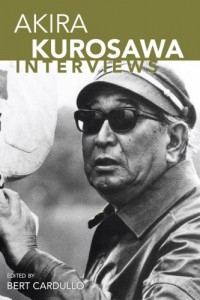 edited by Bert Cardullo
2007, University Press of Mississippi, 233 pages
Published in 2007, Akira Kurosawa: Interviews is the most comprehensive English language collection of interviews with Kurosawa. This makes it the best place to look for a primary source understanding of Kurosawa’s thoughts and ideas. The majority of the interviews come from the 1960s and 1980s, and although only a few translated Japanese interviews are included, the book presents a fairly comprehensive collection.
If you are interested in reading Kurosawa’s views unfiltered, this is the book to get. Akira Kurosawa: Interviews is also an excellent research tool when you need to find that quote from Kurosawa that you think you read somewhere. A more comprehensive review of Akira Kurosawa: Interviews can be found here.
Bert Cardullo has also published a book titled Out of Asia: The Films of Akira Kurosawa, Satyajit Ray, Abbas Kiraostami, and Zhang Yimou; Essays and Interviews. The Kurosawa interview in that book is also included in Akira Kurosawa: Interviews.
Akira Kurosawa – Interviews is widely available, including from Amazon.com, Amazon.co.uk, Amazon.de, and Amazon.co.jp.
Perspectives on Akira Kurosawa
 edited by James Goodwin
1994, G. K. Hall & Co., 300 pages
Perspectives on Akira Kurosawa is a collection of essays, interviews and other writings about Kurosawa, put together and edited by James Goodwin. The book’s first section includes a dozen short notes from film artists ranging from Toshirō Mifune and Satyajit Ray to Andrei Tarkovsky and Steven Spielberg, all saying great things about Kurosawa and his works. The second section is titled “Kurosawa on Kurosawa” and includes ten interviews, some of which were also later included in Bert Cardullo’s Akira Kurosawa: Interviews.
The third and longest section of the book is the most interesting, as it contains more than 30 essays on Kurosawa across some 200 pages. These include articles from such esteemed film critics like Stephen Prince, Donald Richie, Audie Bock, Tadao Sato, Joan Mellen, David Desser, Keiko McDonald and Noël Burch. As is natural, the quality of these essays ranges considerably, but all in all the book is an excellent collection which, thanks to its good index, is also easy to use as a reference volume.
Perspectives on Akira Kurosawa is currently out of print, but can be purchased second hand. Good places to check are Alibris, Abebooks or Used Book Search. Also Amazon.com and Amazon.co.uk have used copies.
Post Script: The Films of Kurosawa Akira
 edited by Keiko McDonald
2000, Post Script Inc., 105 pages
Post Script: Essays in Film and the Humanities is a film studies magazine that has been published by the Texas A&M University and Georgia Institute of Technology since 1971. Volume 20, Number 1 was published in the autumn of 2000 and concentrates exclusively on Akira Kurosawa. The publication includes contributions from Donald Richie, Stephen Prince, David Desser and Keiko McDonald, among others.
As with other essay collections, the quality of the essays varies, and while it may not be the most important collection of Kurosawa criticism out there, the book is certainly well worth getting for content that is not available anywhere else.
Issues of Post Scipt can be ordered from the Texas A&M University Commerce website.
Rashomon
 edited by Donald Richie
2nd edition 1987, Rutgers University Press, 216 pages
The Donald Richie edited Rashomon is a comprehensive collection of reviews and essays on Kurosawa’s film of the same name. The book also includes the short stories on which the film was based, and a continuity script which Richie has put together.
The fifteen essays included in the book are from various Japanese film experts, including Keiko I. McDonald, Joan Mellen, Tadao Sato, Audie E. Bock and Donald Richie himself. They are for the most part very interesting, and the book is definitely a good starting point for anyone wanting to further explore the film which launched Kurosawa’s international career.
Rashomon is still in print and available from bookstores, including Amazon.com, Amazon.co.uk, Amazon.de, and Amazon.co.jp.
Rashomon Effects: Kurosawa, Rashomon and Their Legacies
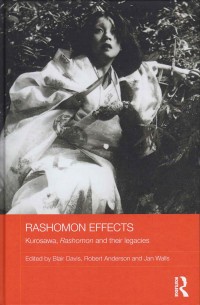 edited by Blair Davis, Robert Anderson and Jan Walls
2015, Routledge, 198 pages
Rashomon Effects is another collection of essays about Rashomon. Unlike the Donald Richie edited earlier collection (see above), this book concentrates on the Rashomon effect more widely, looking not only at the film but also its origins and its later transcultural, transdisciplinary and cross-media influences.
If you have interest in the film and its legacies, this is a great book to have. It must be mentioned however that a third of the chapters are by Donald Richie, Teruyo Nogami and Stephen Prince, and if you are already intimately familiar with the writings of these names, those parts will be fairly familiar territory to you. But even then, the collection certainly succeeds in offering new and interesting approaches to the film and the concept of the Rashomon effect that has been derived from it.
For more information, see the full review of the book.
Rashomon Effects is available from the typical places, including Amazon.com, Amazon.co.uk, Amazon.de, and Amazon.co.jp.
Books with a Specific Focus
Akira Kurosawa and Intertextual Cinema
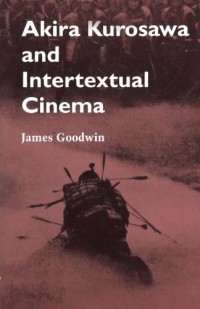 by James Goodwin
1993, The John Hopkins University Press, 280 pages
James Goodwin’s Akira Kurosawa and Intertextual Cinema looks at Kurosawa’s works from the post-structuralist perspectives of intertextualism and interculturalism. In his work, Goodwin not only considers Kurosawa’s direct literary adaptations, but also elaborates on the types of intertextualism present in his other works. Akira Kurosawa and Intertextual Cinema also includes a short look at the intertexts of Kurosawa’s own life, as well as those present in the methods of Kurosawa’s filmmaking.
The discussion in the book is of relatively academic nature, and casual readers may find it somewhat heavier reading than some of the other works available on Kurosawa. It is, however, a very thought provoking and idea filled book, and although one may not agree with every interpretation given in the work, the book is certainly something to be recommended for an advanced student of Kurosawa’s works. A basic knowledge of Kurosawa’s life and works is required before opening this book.
Akira Kurosawa and Intertextual Cinema is available for instance at Amazon.com, Amazon.co.uk, Amazon.de, and Amazon.co.jp.
Censorship of Japanese Films During the U.S. Occupation of Japan:
The Cases of Yasujiro Ozu and Akira Kurosawa
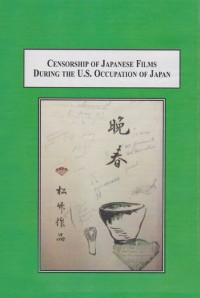 by Lars-Martin Sorensen
2009, Edwin Mellen Press, 338 pages
Lars-Martin Sorensen’s Censorship of Japanese Films is a revised version of the author’s PhD dissertation and therefore fairly academic in its delivery. This is a good thing, for among other things it means that the book has a relatively well defined thesis that it defends throughout, giving the book a good, solid structure that makes it easy to follow. His thesis argues that the typical “good winners, good losers” narrative, which sees the Japanese as having graciously accepted their defeat in World War II, is faulty, and that visible rebellion against the occupying Americans can be found in the films released during the occupation era. The book sets out to show exactly how directors like Ozu and Kurosawa managed to smuggle in anti-occupation sentiments despite the ongoing censorship.
Censorship of Japanese Films must be highly recommended to anyone interested in post-war Japanese cinema and contemporary censorship. Sorensen’s discussion of both Kurosawa and Ozu is both well written and adequately researched. It is perhaps slightly stronger with its historical accounts than with critical interpretation of the films which it discusses. You can find a longer review here.
The availability of Censorship of Japanese Films varies, but copies can typically be attained from Amazon.com, Amazon.co.uk, Amazon.de, and Amazon.co.jp.
Everything I Know About Filmmaking I Learned Watching Seven Samurai
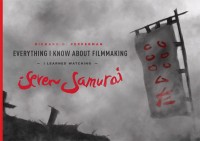 by Richard D. Pepperman
2014, Michael Wiese Productions, 200 pages
This wonderfully titled book by film professional Richard D. Pepperman is basically a commentary track in written form. It goes through Kurosawa’s Seven Samurai scene by scene, explaining what is happening and what filmmaking techniques Kurosawa has used to tell the story. The discussion covers both technical and story techniques and takes altogether 160 pages, with various forewords, appendices and a pretty good index also included. As the book covers a 207 minute film, it does go into fairly good detail in this space.
There are some issues, mainly to do with the occasional lack of academic rigour and the need for more editorial interference. Whether it really teaches you much about filmmaking or ends up saying much new about the film is debatable, but this unique book is worth checking out, especially if you are a fan of the film. You can find a longer review of the book here.
Everything I Know About Filmmaking is available from most well stocked bookstores, including Amazon.com, Amazon.co.uk, Amazon.de, and Amazon.co.jp.
On Kurosawa: A Tribute to the Master Director
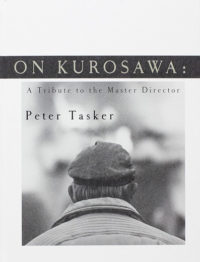 by Peter Tasker
2018, Zen Foto Gallery, 213 pages
Peter Tasker’s collection of Akira Kurosawa related essays, short stories, poems, quotes and pictures is modelled after the Japanese literary genre of zuihitsu, a purposefully fragmented approach to a subject. Some chapters are in their style fairly conventional interpretations or reviews of Kurosawa’s works, while in others the author takes on the role of one of the films’ characters and explores the works in that way. Elsewhere, the author uses his knowledge of his adopted home country to explore biographical and historical details behind Kurosawa’s life and career. Tasker ends up touching all of Kurosawa’s films, as well as many works that Kurosawa was otherwise involved with.
I wouldn’t necessarily pick this if you are completely new to Kurosawa, as the book does require quite a bit of familiarity with the filmography. However, if you are already familiar with Kurosawa’s life and films, and don’t shy away from things like the cat from Madadayo writing to you about the connection between human social customs and alcohol, I can definitely recommend this book to you. It’s fun, it’s interesting, and it’s a really lovely object as well.
For more information, check out my full review.
On Kurosawa: A Tribute to the Master Director is available from Shashasha.co and Amazon.com.
Remaking Kurosawa: Translations and Permutations in Global Cinema
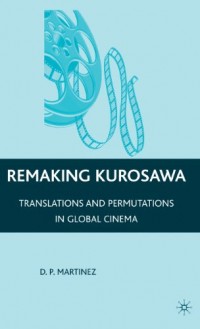 by D. P. Martinez
2009, Palgrave Macmillan, 248 pages
Published in 2009, Dolores Martinez’s Remaking Kurosawa: Translations and Permutations in Global Cinema considers how, and to some extent why, Kurosawa’s films have made the transition from Japanese films into the domain of global cinema. Martinez looks at the way Kurosawa’s works have been translated from one cultural context into another, both as direct translations (by subtitling, dubbing, retelling or remaking) and as less direct permutations (works less loosely based on or simply influenced by Kurosawa’s works, or works based on or influenced by works that themselves were influenced by Kurosawa). Throughout the book, the author returns to questions such as how it is that global audiences can see connections between different works that come from different linguistic and cultural backgrounds, how filmmakers seek to display connections between their own works and those of earlier films, or what in the end gets lost or invented in the process of cross-cultural adaptation.
Martinez’s book is an excellent addition to the Kurosawa catalogue. It approaches its chosen topic from an angle which has often been talked about, but never quite explored with the dedication and enthusiasm that Martinez has given it. For a longer review, see here.
Remaking Kurosawa is generally available from Amazon.com, Amazon.co.uk, Amazon.de, and Amazon.co.jp.
Rhapsody on a Film by Kurosawa
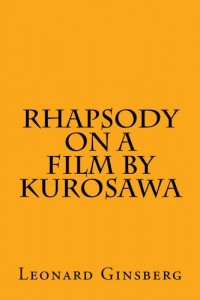 by Leonard Ginsberg
2013, self-published, 242 pages
Leonard Ginsberg’s self-published Rhapsody on a Film by Kurosawa explores the cultural complex and the various permutations that one of Kurosawa’s films has created. Not the one that you would assume from the title, however, as the film in Ginsberg’s target is Yojimbo. Yet, “rhapsody” is a well chosen word for the book’s title, for the text is indeed something of an ecstatic celebration and irregular improvisation.
Ginsberg takes Kurosawa’s Yojimbo as a starting point and starts to weave a web which, ultimately, ends up saying more about the author than it does about other matters. In his at times almost stream of conscious narrative, Ginsberg discusses films like Donnie Darko, Memento and Run Lola Run, but also delves into numerous other subjects such as Shakespeare, Japanese history and the habits of his cat.
Only for the more adventurous.
Rhapsody on a Film by Kurosawa is available exclusively through Amazon.com, Amazon.co.uk, and Amazon.de.
The Samurai Films of Akira Kurosawa
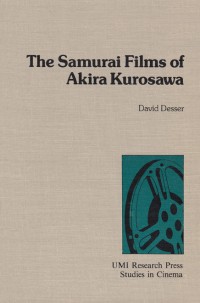 by David Desser
1983, UMI Research Press, 164 pages
The Samurai Films of Akira Kurosawa looks at Kurosawa’s samurai films and was originally written as the author’s PhD dissertation. Desser starts by discussing the genre of samurai films in general and then moves on to Kurosawa’s works, specifically discussing Seven Samurai, The Hidden Fortress, Yojimbo, Sanjuro and Kagemusha. In them, Desser identifies common themes and structures and puts forward a notion of a common formula shared by these works.
The book is well written and informative and has rightly earned a place in the study of Kurosawa’s films in the English language, with many later publications referencing it.
The Samurai Films of Akira Kurosawa has been out of print for a while now, but it can be purchased second hand. Good places to check are Alibris and Abebooks.
Samurai Lear?: The Cross-Cultural Intertextuality of Akira Kurosawa’s Ran
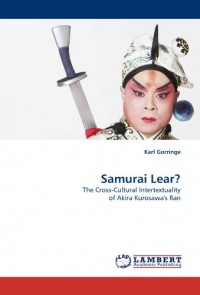 by Karl Gorringe
2011, Lambert Academic Publishing, 112 pages
Samurai Lear? is a print-on-demand publication of the author’s master’s thesis. It approaches Ran not as a Shakespeare adaptation but as a samurai film — not in order to forget the former and more typical approach, but to add to it.
Gorringe’s is an interesting, if not always entirely convincing take on Ran, and the book can only be recommended to those interested in an MA thesis type approach to the film. A fuller review can be found here.
Samurai Lear? is available through Amazon.com, Amazon.co.uk, and Amazon.de.
Seven Samurai
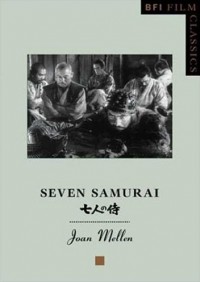 by Joan Mellen
2002, British Film Institute, 79 pages
In just under a hundred pages, renowned film scholar Joan Mellen dissects Seven Samurai, looking at its place in Japanese cinema and Kurosawa’s career, as well as delving deep into the meaning(s) of the film. Mellen argues that Seven Samurai is the most misunderstood of Kurosawa’s works and that at its heart the film is a lament for a lost nobility, and an ultimately very socially conscious work that discusses class distinctions. In her view, the film shows a yearning for an identity which no longer existed in postwar Japan, and she suggests that it reflects the director’s disappointment in what she sees as the downward spiral of Japanese morality.
While the validity of Mellen’s argument depends on your own interpretation of the film, the book is very well written and throughout keeps you interested in the author’s views. For anyone wanting to explore the different aspects and meanings of Seven Samurai, this little book is definitely recommended.
Joan Mellen’s Seven Samurai is in print and available from Amazon.com, Amazon.co.uk, Amazon.de, and Amazon.co.jp.
Seven Samurai
 by Roy Stafford
2001, Longman, 96 pages
Published as part of the York Film Notes’ Ultimate Film Guides series, Roy Stafford’s Seven Samurai is a study guide which lays down the basic facts about the film. The book is intended for A-level students and undergraduates and while it provides an adequate introduction, it should not be of much interest to anyone already familiar with the film and the critical discourse around it.
Roy Stafford’s Seven Samurai is out of print but available from sellers at Amazon.com, Amazon.co.uk, Amazon.de, and Amazon.co.jp.
Art Books
Akira Kurosawa: Complete Drawings
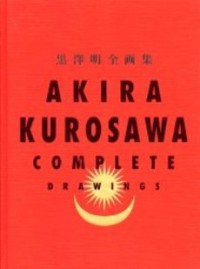 by Akira Kurosawa
1999, Shogakukan, 300 pages
Akira Kurosawa: Complete Drawings is a large (40×30 cm & 4kg, or 16×12 inches & 8.5 pounds) art book that was published after Kurosawa’s death and collects all of his surviving sketches, drawings and paintings. Prepared with Kurosawa Production, this wonderful collection includes a huge number of reproductions, dating back to storyboards from Kurosawa’s early films. Like art books of this size in general, Akira Kurosawa: Complete Drawings is not a cheap purchase, but it is the most complete and the best presented of the various books which collect Kurosawa’s artwork.
Akira Kurosawa: Complete Drawings is available for purchase from Amazon.co.jp, and occasionally also as an import from Amazon.com and Amazon.co.uk.
Akira Kurosawa: Dessins
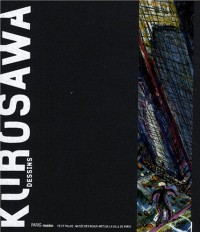 by Akira Kurosawa
2008, Paris Musées, 86 pages
This French art exhibition catalogue is a nice collection that includes 87 of Kurosawa’s drawings and paintings that he did for Kagemusha, Ran, Dreams and Madadayo and The Sea is Watching. The book also includes short introductions to the pictures in French.
At 29×25 cm (11×10 inches) the catalogue is smaller and lighter than Akira Kurosawa: Complete Drawings, but larger than the Kadokawa Art Selection, meaning that the size of the reproductions is between the two other books. The total number of pictures included is greatly smaller than in the two other publications.
Akira Kurosawa: Dessins is available from merchants at Amazon.fr, as well as occasionally from Amazon.com, Amazon.co.uk, Amazon.de, and Amazon.co.jp.
Akira Kurosawa: Kadokawa Art Selection
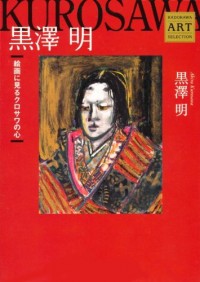 by Akira Kurosawa
2010, Kadokawa Group Publishing, 255 pages
The Kadokawa Art Selection book is a fairly small, pocket sized (15×11 cm, or 5.8×4.2 inches), catalogue of Kurosawa’s drawings and paintings for Kagemusha, Ran, Dreams, Rhapsody in August, Madadayo and The Sea Is Watching, as well as including a handful of other collected works. It is an affordable collection of a little over 200 full colour reprints of Kurosawa’s paintings, but due to its size it is not quite as majestic as Complete Drawings. Like Complete Drawings, it is a Japanese book and primarily only available in Japan.
Akira Kurosawa: Kadokawa Art Selection is generally available from Amazon.co.jp and is occasionally also sold by merchants at Amazon.com, and Amazon.co.uk.
Akira Kurosawa: Master of Cinema
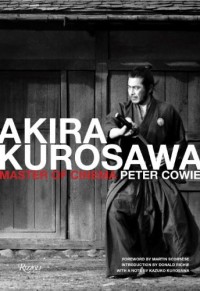 by Peter Cowie
2010, Rizzoli, 304 pages
Peter Cowie’s coffee table book is somewhat difficult to categorise. It could be seen as a basic biography or a light critical work, but in the end the main attraction must be the numerous gorgeous pictures that the book is filled with. These include stills from Kurosawa’s films, posters, pictures of Kurosawa and his family, as well as drawings by both Kurosawa and his close aide Teruyo Nogami. The visual material dominates the book, and one does get the feeling that the primary purpose of the accompanying text is to fill up the spaces around the images and to offer a thematic arrangement.
As such, Akira Kurosawa: Master of Cinema is an excellent coffee table book and a good conversation starter, but not really an invaluable source of textual information about Kurosawa. A full review is available here.
Akira Kurosawa: Master of Cinema is available from Amazon.com, Amazon.co.uk, Amazon.de, and Amazon.co.jp.
Kurosawa: Desenler (Drawings)
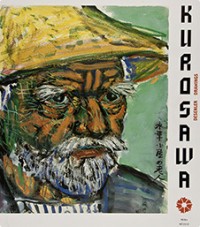 by Akira Kurosawa + various
2009, Pera Müzesi, 117 pages
Kurosawa: Desenler (Drawings) is the official catalogue for the Turkish exhibition of Kurosawa’s drawings which took place in 2009. It is bilingual in Turkish and English and includes 87 storyboard illustrations from Ran, Kagemusha, Dreams, Madadayo and The Sea Is Watching.
The size of the book is 24 x 28 cm, or 9.4 x 11 inches.
The book can be found at the Pera Museum’s webshop and second hand copies occasionally pop up also at Amazon.com, Amazon.co.uk and Amazon.de.
Ran: Original Screenplay & Storyboards of the Academy Award-Winning Film
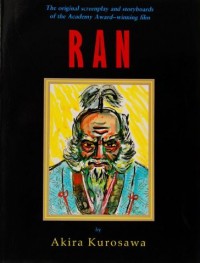 by Akira Kurosawa
1986, Shambhala, 110 pages
This US only publication is a translated screenplay of Ran, accompanied by reproductions of storyboards which Kurosawa drew and painted for the film. It is a fairly good sized art book (11.6 x 8.7 inches or 29 x 22 cm) and a lovely way to experience the story. The publication includes altogether about 70 full colour reproductions.
Ran: Original Screenplay & Storyboards of the Academy Award-Winning Filmg is out of print but is available second hand, including from marketplace sellers at Amazon.com.
夢 (Yume)
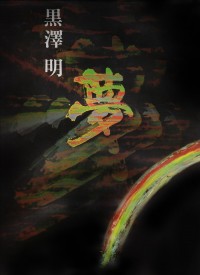 by Akira Kurosawa
1990, Iwanami Shoten, 151 pages
Published around the time of the release of Kurosawa’s film Dreams, Yume is a Japanese book which contains the original screenplay (in Japanese) and 120 full colour storyboard drawings that Kurosawa made for the film. The hard cover publication is of good size (30 x 23 cm, or 11.8 x 9.1 inches) and the print quality is good. Like the Ran publication, it is an excellent way to revisit the film and immerse yourself in the images which Kurosawa had in his head while preparing it, although the screenplay is not translated.
As the screenplay included is the shooting script, the book does not include the sequences which were dropped, including the illustrations for the “I Fly” dream.
Yume is generally available second hand from Amazon.co.jp and as many of the merchants post abroad, it is also available through Amazon.com, and Amazon.co.uk.