
The Quiet Duel: Shooting sequence
-
22 February 2009
Ugetsu
23 February 2009
Jeremy
It likely more to do with not knowing where to go with the ending. Inspiration often drifts scene to scene, with the ending scenes being among the most difficult to maintain one’s inspiration.
I never met anyone completely satisfied with a way a movie ends, they simply settle for something, and that something rarely gives them much inspiration compared to that of the beginning and middle. No one is immune from this problem.
This also has nothing to do with the style of direction, and while I have no clue how this movie was shot, I doubt it was done in sequence.
24 February 2009
Ugetsu
I never met anyone completely satisfied with a way a movie ends, they simply settle for something, and that something rarely gives them much inspiration compared to that of the beginning and middle. No one is immune from this problem.
I find that very interesting – I have a bit of an obsession with movie endings – I always think that a movie with a bad ending means the film maker really didn’t know where he was going with a story. One reason I feel so disenchanted with modern films is that so few seem to know how to finish the story. To me a proper ending makes you rethink the entire film, reinterpret everything you’ve seen. Most of Kurosawas endings do this. Ozu of course was a master of twisting the emotional knife in the final scene. Mizoguchi too – I love the endings of Sansho the Bailiff and especially Akasen Chitai.
24 February 2009
Jeremy
By the way- that “anyone” I should of said director.
To me, both Richie and you are correct. A mixture of not knowing were to go, and a lack of motivation due to it.
It doesn’t at all assume the movie was shot in sequence, as I was saying every scene should be considered an individual.
Attitude, motivation, and directing “magic” swing widely from scene to scene and rarely have any cross over. It can’t be assumed that because the end is considered weaker, that it must of been done towards the end of the production. Very easily, and not entirely uncommonly, a great scene can be done before or after a bad scene.
In this case, the core problem is not so much in what stage of production the ending was filmed, but Kurosawa’s satisfaction of the ending.
I am just speculation here, and in hate even trying pretend to be able to speak on behalf of Kurosawa, or any director for that matter. Still no one can escape the hardships of wrapping up a movie, even the best can be caught up in being unsure what to do, and have their regular “magic” drained due to it. I would even bet, the likes of Ozu, never really ended a movie to his satisfaction, but instead settled on some sort of sacrifice. The mastery of the endings, is simply his ability to hide his mistakes, and not necessary his ability to ever get the perfect ending.
Plus, Kurosawa was still in his learning stages.
25 February 2009
Vili
I doubt that the film was shot in sequence, or at least I can’t remember seeing any reference to it, but it doesn’t necessarily mean that Kurosawa didn’t “lose interest” in some way. I have actually often noticed that Kurosawa’s films tend to work in a way that the first half is better planned and executed than the second. I’m not saying that his films collapse, or that I lose interest in them, but simply that I time and time again find myself with the feeling that the early parts are slightly superior to the late parts.
This may be due to what Jeremy said about directors not really being happy with their endings. But also, while I don’t actually know how Kurosawa and his writers dealt with their scripts, I have for some reason always assumed that, considering Kurosawa’s various comments about script writing, the scripts were written in sequence, from the beginning to the end, and then revised. If that is true, it could explain why the first parts often work the best.
Having said that, I actually find it interesting how the first scenes in Quiet Duel are praised so much in contrast to the rest of the film. I can see where that is coming from, but personally I tend to prefer the movie once it moves off the field hospital location. Kurosawa’s direction becomes more straightforward and less distracting, and the film to me appears to (strangely enough) become less artificial once it moves to the sound stage. But this is just a personal preference, really.
And I actually have a strong feeling that I am currently not at all “in tune” with film criticism or actually films themselves. I haven’t seen a movie new to me in months that I would actually have liked all that much. This, even if I have mainly watched films that have been highly praised. Usually, I find myself pretty much agreeing with the general consensus, but right now this doesn’t seem to be the case. But this is not really relevant to the topic, so I’ll stop here.
11 March 2009
cocoskyavitch

Hola friends! Back from Mexico last night.
I’m with Vili in his estimation of the relative pleasure of “Quiet Duel”…my personal feeling is that the second part of the film has been sacrificed on the critical altar. There’s plenty of stuff to admire in the second half of the film.
Donald Richie does point out the fabulous character of the bad-girl-turned-good-nurse-in-training. Her personal developmental arc is really an interesting transformation. She’s stellar, and so much fun to watch. I think she is an example of a really strong female character.
Although Kurosawa is not considered a director with much interest in female characters, I think that’s a cheap idea that hasn’t been thought through carefully enough. The young girlfriend/dancer in Stray Dog is a wonderful creation of the petulant, headstrong young lady who makes her mom worry-and, transplanting her into today-I can see her in any number of headstrong young women in my community. She’s a type not at all irrelevant today…and may even be an archetype-someone we see again and again making those poor choices (until, in the film, her final capitulation to decency).
And, the young bad-girl-turned-nurse-in-training in The Quiet Duel is another example of a girl who needs to make a moral choice-who is hell-bent for badness, but who makes a choice for good. And, she is really interesting to watch.
Yes, the message is a bit heavily sentimental, and less conflicted in resolution than most of Kurosawa’s really interesting puzzle films-but, there is tremendous pleasure in seeing Mifune young, handsome, strong, and struggling with his inner conflict. And, it is always good to see Shimura in the wise, older role. It seems to me that these actors and the characters they portray provide some real human warmth in their stories, and that this kind of melodrama actually serves a real social function, encouraging the audience to make good choices. It may seem a bit Pollyanna-goodie-two-shoes-ish, but while you may say “ah, this is too sweet…” still, it has a surprisingly strong aftertaste. And, I mean that in a good way.
24 July 2011
Ugetsu
Coco
And, the young bad-girl-turned-nurse-in-training in The Quiet Duel is another example of a girl who needs to make a moral choice-who is hell-bent for badness, but who makes a choice for good. And, she is really interesting to watch.
She didn’t make much of an impression on me on my first viewing, but on my second viewing I agree – I think she’s a great character, very well performed, and unusually I found myself watching her rather than Mifune in their scenes together.
Which incidentally, brings me to an interesting contribution to the discussion we had a while ago about female characters in movies in general – this nice essay about how there aren’t enough weak female characters in films these days.
25 July 2011
Vili
I too was thinking about her character when last watching the film. The character grows on you, and as you say, the performance by Noriko Sengoku is probably the best in the film.
I’m not sure what to make of the need for more “weak/flawed” female characters. I’m just happy if a film happens to have a character that feels real, regardless of gender. And as you recently mentioned in another thread here, Kurosawa was quite good at writing life-like characters.
28 July 2011
Ugetsu
Vili
The character grows on you, and as you say, the performance by Noriko Sengoku is probably the best in the film.
I think she did carry it off very well, especially the sudden switch from being unsympathetic to being more likeable. Interestingly, I see that she didn’t have many big roles in her career, but was still acting up to 2007.
Much as I love Mifune, I can’t help thinking that this is another case where maybe Kurosawa failed a little, allowing Mifune to dominate scenes too much at the expense in particular of female characters. There are times when he even seems to physically grab the center of the scene at Rui’s expense.
29 July 2011
Vili
Ugetsu: Much as I love Mifune, I can’t help thinking that this is another case where maybe Kurosawa failed a little, allowing Mifune to dominate scenes too much at the expense in particular of female characters. There are times when he even seems to physically grab the center of the scene at Rui’s expense.
I don’t think that I agree with you here, Ugetsu. For me, Rui works marvellously as a character who is not at the centre of things, but is nevertheless almost always there — bumping in at the most inappropriate times, and constantly hovering on an orbit around Kyoji.
Coming to think of it, in these terms Rui is actually not very different from Kyoji’s fiancée, who is on a very similar orbit for the first half of the film. Although she can’t quite match the inappropriateness of Rui’s sense of timing, of course.
29 July 2011
Ugetsu
Vili
bumping in at the most inappropriate times, and constantly hovering on an orbit around Kyoji.
That’s a very good description of how she is in much of the film, you articulated exactly what I was trying to put my finger on, and failing. So often, she is just moving around, like a satellite around Kyoji. I assume this is deliberate, as it seems to me she is often literally at the edge of the frame sometimes. Is it perhaps meant to symbolize the failure of these two women to become penetrate to the hart of the problem represented by the ‘disease’?
I hadn’t seen the Quiet Duel before, my first viewing was last week, and as its a rental DVD I didn’t have a chance for a second look.
I have to say I did enjoy it a lot – obviously its very melodramatic and the most dated of any of AK’s movies I’ve seen, but I found it quite gripping and very interesting – I am always fascinated by the way both AK and Ozu used the ruined cityscapes of post 1945 Japan for background effect. But as both Richie and Prince imply (and I find it hard to disagree), its not a philosophically interesting film, there really isn’t a lot to say about it (although I hope someone here will find something).
But two things struck me about it:
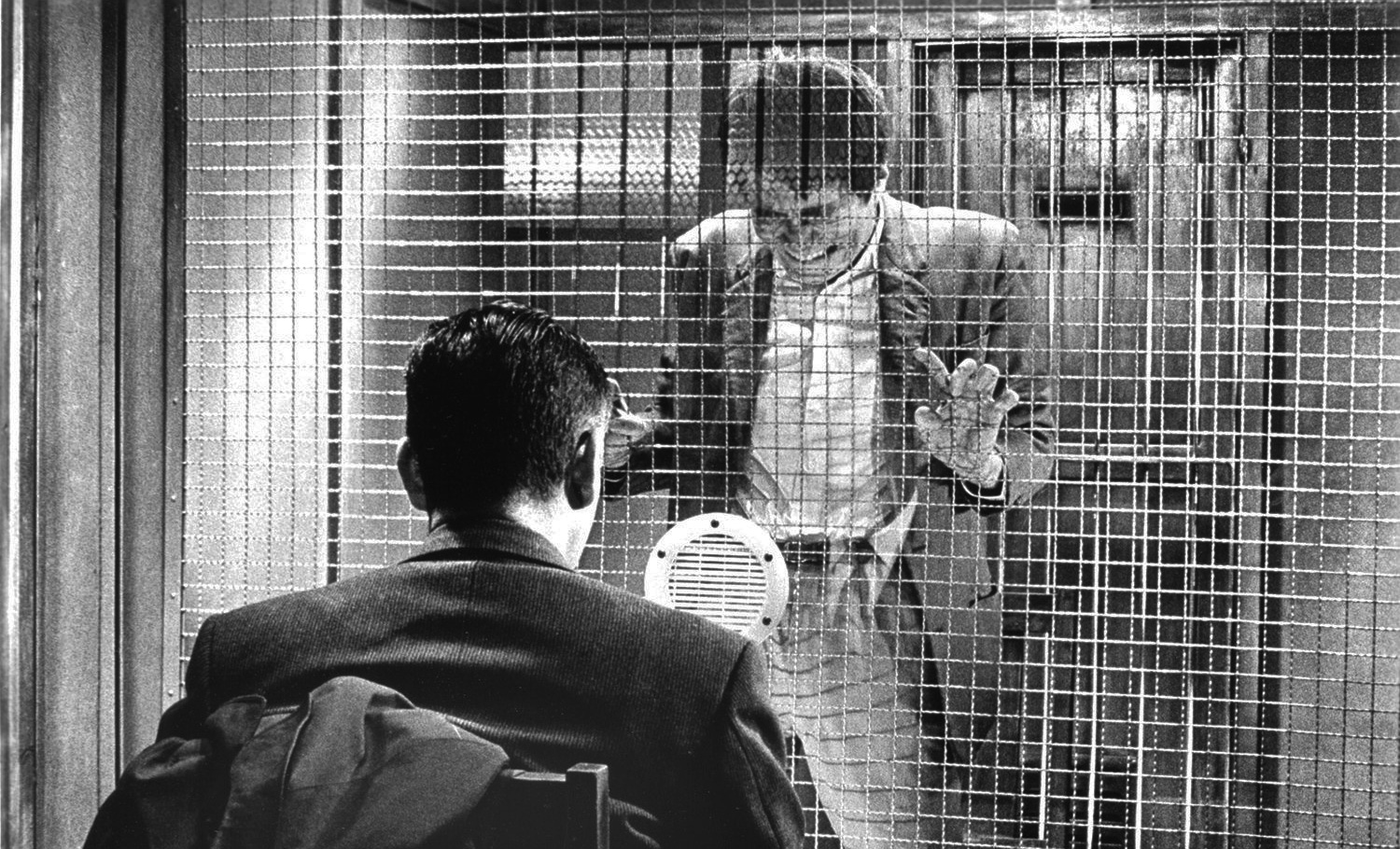
The first scenes seemed to be all we expect from AK – brilliant composition, editing and shooting, a great mix of roving camera work and clever editing. But as the film goes on, it seemed to me that the shooting lacked his customary skill. In particular, the final confrontation scene in the hospital corridor seemed oddly cramped and theatrical. Richie notes this as well (I deliberately didn’t read Richie’s analysis until I saw the film), and attributes this to AK losing interest:
He also says that AK attributed the loss of focus to moving the filming to the studios in Tokyo.
The second thing I noticed was the trailer. I may be wrong in this, I didn’t have time to do a detailed comparison, but it seems to me that lots of the early scenes shown in the trailer are actually different from in the film. Now, I don’t know how trailers were made in that, but I assume one reason could have been that the trailer was made before shooting was completed, so AK was asked to quickly do a few set ups. But it is the early scenes that seem different, not the later ones, which seems to imply that the film was not shot in sequence.
I know nothing about how films were shot at the time, but I assume that for budgetary reasons films of that period were not shot in sequence – the trailer for me seemed to back this up. But if so, does this undermine the notion of analyzing the film as if AK simply lost interest? Or is it (as I think more likely), AK just couldn’t find anything inspiring to do with the ending, so simply fell back on a bit of melodrama?